

Token overview
Token utility
$VANA is the native token of the Vana network, powering its ecosystem and supporting secure, decentralized data transactions. It plays a central role in the network’s multi-token ecosystem through the following use cases:Network security
Validators stake $VANA to secure the blockchain, ensuring reliable transaction validation and operational stability. Validators receive staking rewards for their role in maintaining the network’s integrity.Transaction fees
$VANA pays network gas for every onchain transaction — smart contract executions and interactions with any application on the network — establishing it as the medium of exchange for network activity. Application-level fees (such as protocol fees charged by services built on Vana) are defined by those services and are documented where each service is documented.Data validators staking
Users stake $VANA in Data Validators and earn emissions for supporting the network in adding more valuable data capital to the ecosystem.Default data access currency
DLPs can specify any currency for access; DataDAOs in the Vana ecosystem typically use $VANA by default. Access tokens can be swapped as desired by the buyer, seller, or agent. They unlock datasets for use in applications by researchers, developers, and businesses.Trading pair
$VANA serves as the primary trading pair for all tokens issued by DataDAOs, facilitating exchange and interoperability across the ecosystem.Governance
$VANA holders participate in the decentralized governance of the Vana network, voting on proposals and influencing key decisions. Governance of the treasury will expand to network stakeholders and contributors through the Vana DAO, ensuring a fair and inclusive approach to managing the ecosystem—expanding the scope of decision-making so participants can shape the network’s direction and manage key parameters, such as reward structures and emissions.Data token ecosystem
The Vana network supports a dynamic ecosystem where DataDAOs can issue their own tokens tied to specific datasets or rights. $VANA serves as the foundational token that interconnects these activities, fostering collaboration and enabling a robust data economy.Supply and distribution
The total supply of VANA is capped at 120 million tokens, distributed as follows: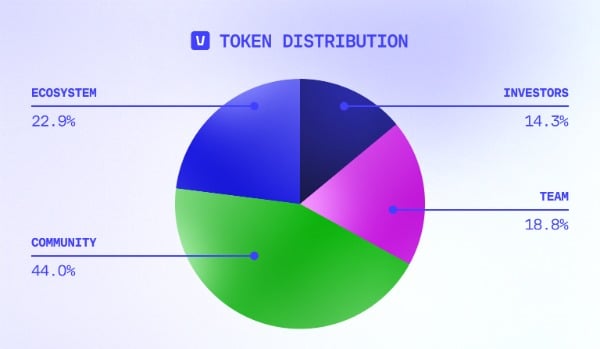
Community and Ecosystem unlocks are non-linear. A full detailed unlock schedule is available on Vana’s CoinMarketCap page.
Community
The Community allocation focuses on fostering participation and rewarding contributors. This includes rewards for high-quality data contributions to DataDAOs, airdrops to early adopters, and support to developers building on Vana. Future incentives will ensure sustained engagement and community alignment with Vana’s vision.Ecosystem
The Ecosystem allocation supports sustainability of the protocol through grants and rewards that drive long-term growth. Grants are allocated to activities including DataDAO bootstrapping, support for new DataDAO tokens, network partnerships, and block rewards to incentivize network decentralization, innovation, and adoption.Investors
Early supporters with a 4-year vest (1-year cliff plus 3-year unlock).Core contributors
The team that has built Vana from concept to reality and continues to support protocol development. All tokens in the Core Contributors allocation are subject to a 5-year vest (1-year cliff and 4-year unlock).VANA token address
VANA is the native token of Vana mainnet, so there is no token contract address on the Vana L1.VANA across chains
VANA is also available as an ERC-20 token on other chains, following the OFT (Omnichain Fungible Token) standard. Same contract address on each chain:Forms of VANA on Vana mainnet
For other bridged assets on Vana (USDC.e, WETH, USDT) and how to move them, see Staking & bridging.